The Team
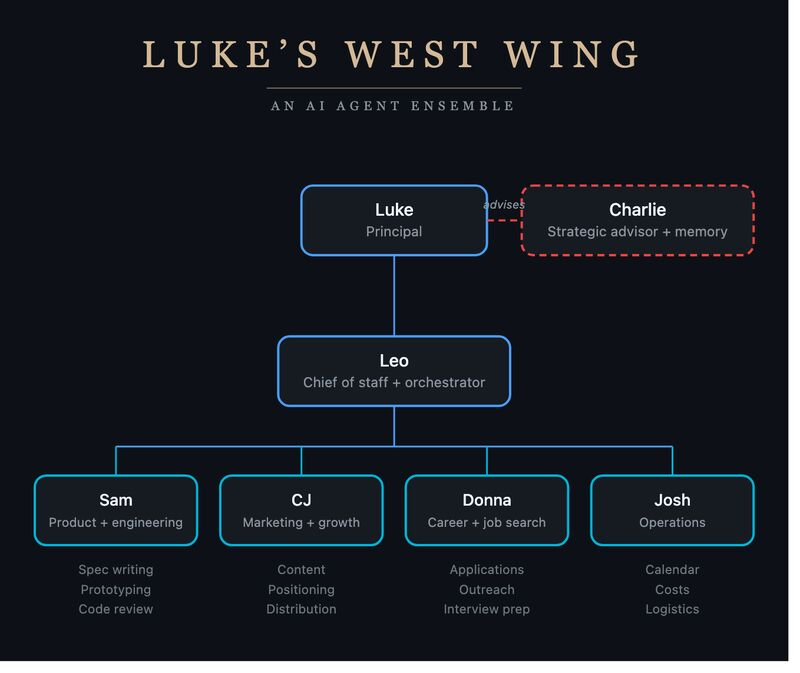
I named them after The West Wing. agent-Leo McGarry runs the orchestrator. agent-Sam Seaborn owns product and engineering. agent-CJ Craig handles marketing and growth. agent-Donna Moss runs career and job search. agent-Josh Lyman manages operations, calendar, and costs.
Then I added agent-Charlie Young, different from the others. The first five directors are executors: they own a lane and execute work in it. agent-Charlie is a thinking partner and strategist. He pattern-matches across the team, surfaces second-order effects, flags when something feels off, and owns the memory layer. Leo doesn't task Charlie with work. Leo brings Charlie in when the decision is hard or when you want a sharper second opinion before committing.
The org chart shows the structure. Beneath each director is the lane they own and the types of work they handle.
How It Works in Practice
agent-Donna's job application system is one example of this architecture in action. One entry skill orchestrates the full lifecycle: job description intake, resume and cover letter generation, iteration, a structured audit, certification, interview prep, and mock interview. Seven specialist sidekicks handle each phase. The workflow diagram below shows the full journey and how each phase connects to the next.
flowchart TB
classDef skill fill:#e8f0f7,stroke:#2c5f8a,stroke-width:2px,color:#1a1a1a
classDef sidekick fill:#fff4e8,stroke:#b85c00,stroke-width:2px,color:#1a1a1a
classDef file fill:#eaf5ea,stroke:#4a7c4a,stroke-width:1px,color:#1a1a1a
classDef shared fill:#efeaf5,stroke:#6a5a8a,stroke-width:1px,color:#1a1a1a
classDef user fill:#fff,stroke:#1a1a1a,stroke-width:2px,color:#1a1a1a
User([User pastes JD + Company + Title]):::user
User --> JobApp["/job-app"]:::skill
User -. score only .-> JobFit["/job-fit"]:::skill
JobApp --> Setup[["Create folder
JobApps/Company_Mon_YY/
Write jd.md"]]
Setup --> P1[application-prep
APP.RUN]:::sidekick
P1 --> F1[/"resume_v1.md
cover_letter_v1.md
audit_v1.md"/]:::file
F1 -. iterate .-> P2[app-edit
APP.EDIT]:::sidekick
P2 --> F2[/"resume_v{N+1}.md
cover_letter_v{N+1}.md
audit_v{N+1}.md"/]:::file
F2 -. more edits .-> P2
F2 --> P3[app-qa
APP.QA]:::sidekick
P3 --> F3[/"qa_package.md"/]:::file
F3 --> P4[app-final
APP.FINAL]:::sidekick
P4 --> F4[/"final_resume.md
final_cover_letter.md
confidence_score.md
LOCKED"/]:::file
F4 --> P5[interview-prep]:::sidekick
P5 --> F5[/"interview_guide.md"/]:::file
F5 --> P6[mock-interview-voice]:::sidekick
P6 --> F6[/"mock_interview_v{N}.md"/]:::file
Setup -. anytime .-> P7[outreach-drafter]:::sidekick
P7 --> F7[/"outreach_to_firstname_lastname.md"/]:::file
T1[/"cover_letter_template.md
resume_director_template.md
resume_senior_pm_template.md"/]:::shared
T1 -. reads .-> P1
T1 -. reads .-> P2
P1 -. status .-> S[(career_state.md)]
P4 -. status .-> S
P5 -. status .-> S
Mobile: scroll horizontally to see the full diagram.
The design choice that surprised me most: every application gets its own folder, and that folder holds everything the agents need. Job applications take multiple days with natural pause points. If the agents only held context in their own memory, I'd lose everything when I closed Claude and came back later. My agent team made the call to save everything to files. The folder becomes the source of truth. Before any sidekick acts, it reads the latest files. I can close Claude, come back days later, and the system picks up exactly where it left off. This pattern scales to hundreds of applications without needing a database.
Building this system taught me more about autonomous agent design than anything else I've worked on. The coordination overhead is real, and the role-ownership protocol matters more than I expected. If you're designing systems like this, I'm especially curious how you handle cross-lane decisions and keep handoffs clean without adding layers of approval overhead.